

Reading time: 4 minutes
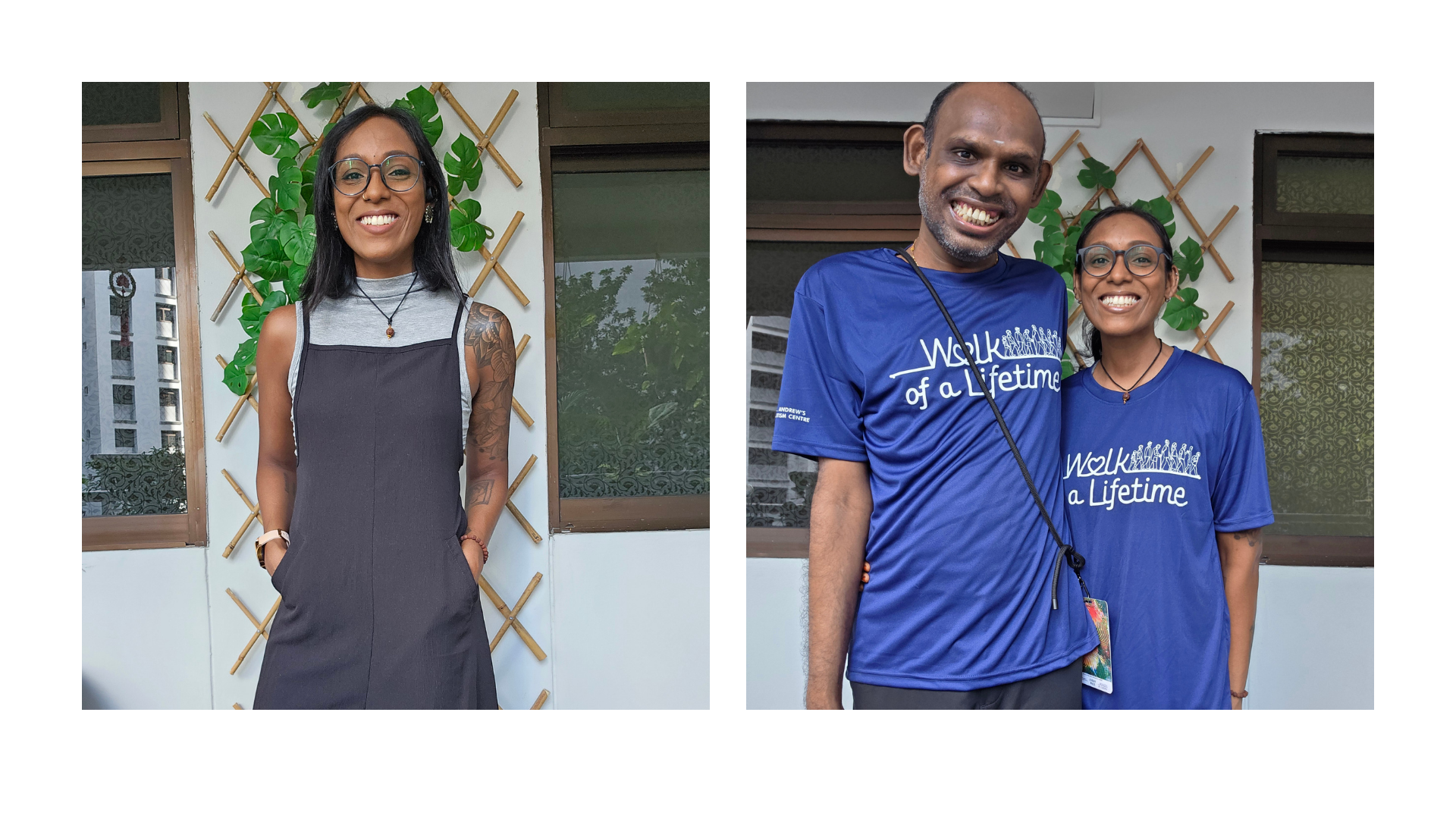
Karasi Chandramogan is a senior behavioural therapist from Singapore who cares for her non-verbal autistic older brother. After struggling to find information tailored to the needs of Singaporean sibs, Karasi launched her Instagram community Autism Sibling Hope two years ago. Through the platform, she shares her everyday experiences and personal advice as a sibling carer, helping others to feel less alone and better equipped in their caring role.
Tell me about your Instagram community for siblings. How and why did it all come about?
For a really long time, since probably after I studied engineering, I was trying to seek out similar people like me, siblings with special needs. It kind of hit me: I couldn’t be the only one in this situation.
At that time, when I was in my early twenties, I think social media was just getting the hang of hashtags. So I kept searching hashtags for special needs sibling. I noticed every time when I found certain hashtags, it was always related to something from the UK, from Australia, from America, from New Zealand and all those countries – Western countries. But then I was thinking, what about Singapore? Like, why isn’t there anyone? I can’t be the only one, right?
I think it went on for a good, maybe, 10+ years, and then after that COVID hit, we all went into Zoom mode and a lot of us were on social media. Suddenly I saw this group called Sibs Unite. Sibs Unite catered to what I was looking for: a support group, where we all could share and rant about our siblings, our own experiences. At that time, I realised that Sibs Unite were doing more meetings, programs and workshops.
I was thinking from my point of view (as a sibling) and then I was thinking from my client’s point of view (my clients who have special needs, who have siblings) that what they want is to find infographic based information. It was about two years ago when I decided to come up with Autism Sibling Hope, the Instagram page where I started sharing about my experiences and then sharing certain advice with regards to being a caregiver or the sibling experience. And I tried to cater it towards the Singaporean context as well, so that Singaporean siblings could turn to this page.
What’s the hardest thing and the best thing about being a sib?
I think the hardest thing is the quiet load that we carry as a special needs sibling because there’s that constant mental load of planning, worrying, anticipating everything that’s happening every day. And it’s not something that you can kind of take a break from, you know?
Even if I plan to go on a holiday, months beforehand I have to mentally prep that. I need to make sure these days that I’m away, he has the medications. That’s enough for him. There is no doctor’s appointment on the week that I’m traveling. That food can be delivered, making sure the food isn’t too spicy for him and catering all of those thoughts.
I think that’s the hardest thing about being a sibling, having all those quiet loads to handle. That mental load is something that a lot of people don’t realise. They don’t think about it. They think about the external caregiving or the sibling experience, but they do not realise the internal thought process that goes through on a day-to-day basis.
I think there’s a genuine guilt that’s really hard because sometimes I feel bad when I enjoy certain experiences. But my brother being cognitively in a 3- to 4-year-old state, he doesn’t understand or enjoy certain things. He follows so many routines.
There is that sense of loneliness that sometimes I feel when I do see siblings, like with my husband and his sister, when they quarrel or they discuss family things. I don’t have that. I think it’s something that other people might have a hard time understanding.
Recently when I fell sick – it doesn’t end there! I don’t get to rest! You know, I still have to wear a mask around my brother and handle the situation as well.
I think the best thing would be the part on empathy. I realised meeting a lot of other siblings as well, we all have this sense of empathy. We kind of have this clarity towards the quality of life. In Singapore, it’s very hustle, it’s very competitive, even education is competitive. There’s this checklist in Singapore, you get a degree, you fall in love, you get married, you get a house. That’s how the list goes by. But as siblings, we have a very different experience. We get that clarity of slowing down and kind of celebrating different wins, I guess. Which is not part of the societal norms.
When I see my friends, when they say: ‘Oh, I’m 35, I’m divorced, I don’t have a house’ and they are quite sad about it. I tell them: ‘But that’s the society standard. It’s a standard that we put on ourselves.’ And I think my friends realised that I have that clarity because of my brother, the shared experience that we see growth differently. We see humanity differently. We are a lot slower in that sense, especially in Singapore. We don’t get into the hustle.
What do you wish non-siblings understood about sibhood?
As a special needs sibling, regardless of whether I’m the caregiver or not, I hope other non-siblings try to understand that it’s not just about helping out.
It’s a lifelong thing that you have to go through, whether it’s emotional, the logistics, it’s lifelong, because our parents surpass us. The sibling is the one that’s with us till the end. And when I see it from that perspective, I think a lot of other non-siblings don’t see it that way.
They see their brother or sister get married, have a family and all that stuff. But for us the helping out doesn’t end. We plan for the future, how we show up in relationships because of our sibling experiences, how we make decisions. It’s very different from non-siblings because for us, the thought process is: ‘If I’m gonna bring Bala out for a family event, is the place safe? Is the place noisy? Are there gonna be kids around? Are people gonna be giving out food for him?’ Because Bala doesn’t have a sense of being full, so he’ll just keep chewing, drinking everything nonstop. It’s very complex.
What’s the one thing they could do to support sibs?
Not romanticising about the strength perspective, like: ‘Oh, you are so sweet! You are such a lovely sister to do all of these things for your brother!’ But I’m just like: ‘There are days that I don’t want do this.’
From an Asian perspective there is this: ‘Oh, you take care of your brother, like your son!’ And I’m like: ‘No, no.’ I will always stand by trying to not blur the line between the sibling and the parent role because it’s very easy for us to get blurred into that part.
There are days where I do get irritated with my brother. There are days where I just want to be the younger sister. I just want to annoy him or I don’t want to be near him! I think the true raw emotions and the experiences are what actually helps us sustain ourselves. It’s not inspirational.
Also just asking: ‘How are you holding up today?’ Just simple questions. I have this long-distance best friend, she will always say if I am not in her top three chat groups, she would immediately text me like: ‘Okay, how are you? What’s happening?’ You know, she checks on up on me in that manner. They offer small but practical support without the pity portion.
What else would you like other sibs to know?
I think reminding them that it’s okay to have all of these mixed emotions of like, being tired, being protective, being guilty, being shaken at times. Having all of those emotions, it’s fine. We should come to a place where we are more open to sharing that. You know, the burnout is real. The guilt is there. There are days that you celebrate little joys, like maybe him eating something new. You know, the simplest of joys and enjoying that.
I think also reminding them that the love that we have for our siblings is real. It doesn’t have to be how it’s portrayed. Shows, movies, or maybe another family, they might have a very nice sibling experience, maybe the sibling is more cognitively able to share the experience or share the love. The love that I have with my brother, it doesn’t seem mutual, but I know Bala loves me in his own ways. When we are walking on a pathway, he’ll walk in front, but he’ll turn around to look at me and check up on me, in a small, older brother manner, he will check on me.
Also that rest is important. Your own identity is important. It doesn’t have to revolve around your sibling all the time. Learn what you love, learn who you are as a person. Have hobbies, keep your sanity in different ways, like going to the gym, having your rest. Learning to have a life outside of caregiving. And having a life outside being a sibling as well.